

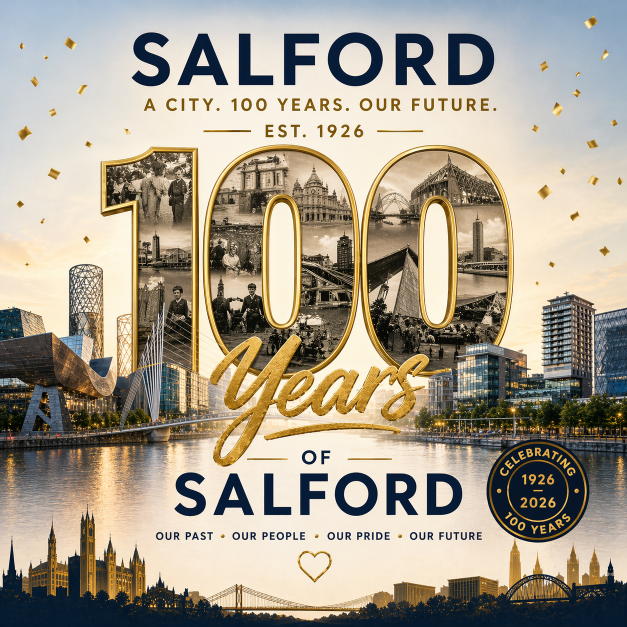
On this day, the 21st April 2026, Salford celebrates a remarkable milestone—100 years since it was officially granted city status. Nestled alongside Manchester in the heart of Greater Manchester, Salford’s story is one of grit, transformation, and enduring community spirit. Over the past century, it has evolved from an industrial powerhouse into a dynamic cultural and economic hub, all while holding tightly to its distinctive identity.
Salford’s roots stretch far beyond 1926, but its elevation to city status marked a turning point. In the early 20th century, it was defined by industry—textiles, engineering, and bustling docks along the Manchester Ship Canal. The skyline was dominated by mills and smokestacks, and the rhythm of life was set by the hum of machinery and working people. Communities were tight-knit, shaped by shared labour and resilience in the face of hardship.
However, like many industrial cities, Salford faced significant challenges in the mid-20th century. Deindustrialisation led to job losses and economic decline, leaving lasting scars on the landscape and its communities. Yet Salford’s story did not end there. Instead, it became a story of reinvention.
The regeneration of Salford Quays stands as one of the most visible symbols of this transformation. Once derelict docklands, the area has been reborn into a vibrant waterfront destination. Today, it is home to cultural landmarks, thriving businesses, and media institutions that have brought new energy and opportunity to the city. This shift has not only boosted the local economy but also reshaped how Salford is perceived—both nationally and internationally.
Culture has played a central role in Salford’s identity over the past century. The city has produced and inspired some of Britain’s most celebrated artists, writers, and performers. Its working-class roots have long informed its creative output, giving voice to stories that are raw, honest, and deeply human. From theatre and music to visual arts, Salford continues to punch above its weight culturally, offering a platform for both established and emerging talent.
Education and innovation have also become key pillars of modern Salford. Institutions like the University of Salford have helped position the city as a centre for research, creativity, and digital advancement. Partnerships between academia, industry, and the community are shaping a forward-looking city that embraces change while respecting its past.
Yet, perhaps the most defining feature of Salford at 100 is its people. Through every period of change—industrial growth, decline, and regeneration—it is the strength and solidarity of its communities that have carried the city forward. There is a deep sense of pride in Salford, a recognition of where it has come from and a shared optimism about where it is going.
As Salford marks its centenary, it is not just a celebration of history, but a statement of intent. The city continues to evolve, balancing heritage with innovation, and local character with global ambition. One hundred years on, Salford stands as a testament to resilience—a city that has weathered change and emerged stronger, ready to write the next chapter of its story.
You may also be interested in...
 Community
 Community
 Community

Value my property today
Lorem Ipsum has been the industry’s standard dummy text ever since the 1500s, when an unknown printer took a galley of type and scrambled it to make a type specimen book. It has survived not only five centuries